
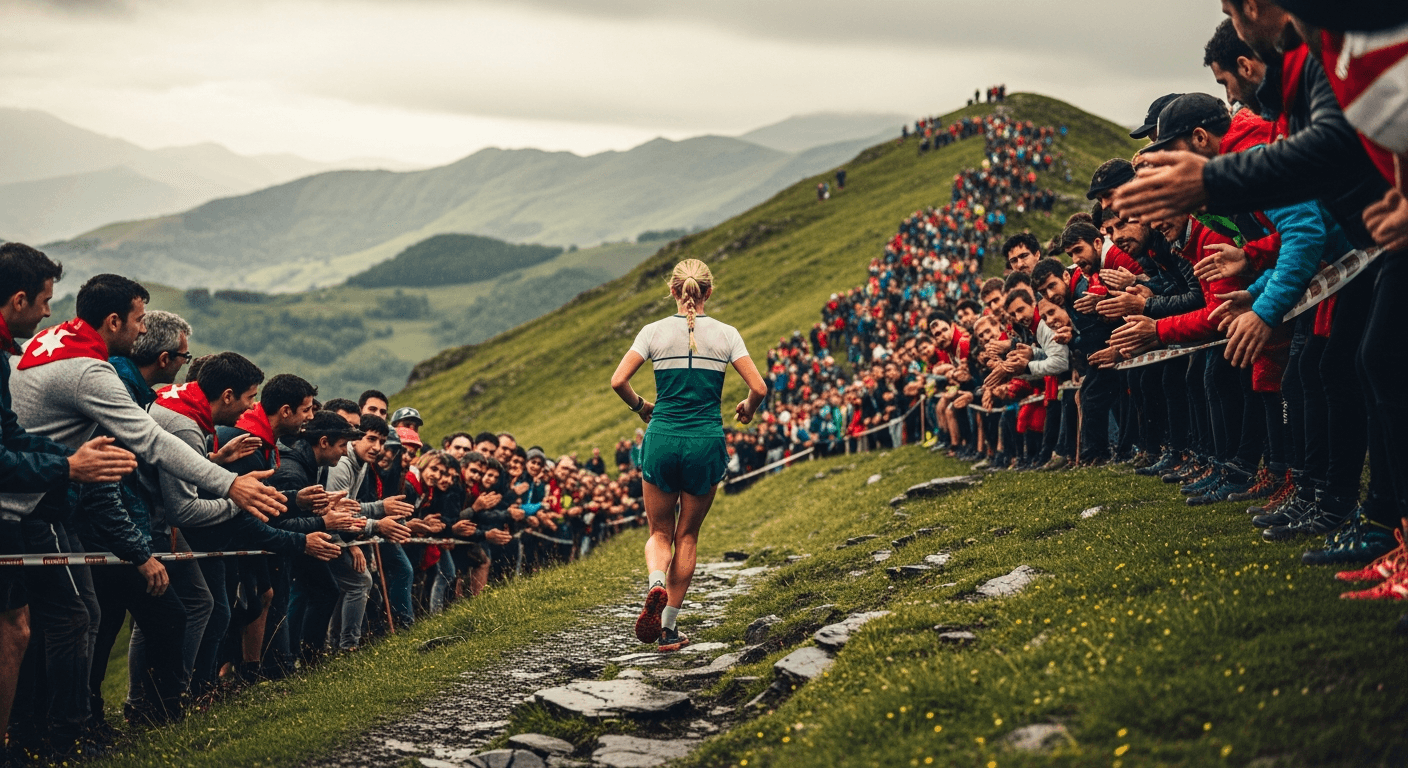
Some athletes win a race. Others redefine what winning looks like. Tove Alexandersson belongs to the second category, and her 2026 victory at the Zegama-Aizkorri Marathon made that case more forcefully than ever.
On the rain-soaked ridgelines of the Basque Country, Alexandersson crossed the finish line in Zegama for what has become a near-annual ritual. Another title. Another margin that left the field searching for answers. Another performance that forces the trail running world to ask: is anyone actually closing the gap?
What Makes Zegama So Hard to Win Twice
The Zegama-Aizkorri Marathon is not a course that rewards one-dimensional runners. Held in the Basque hills of northern Spain, the race covers roughly 42 kilometers with over 2,800 meters of elevation gain. The terrain is technical in the way that only limestone-heavy, wet European mountain trails can be. Slick rock, steep descents, and unpredictable weather are the norm, not the exception.
Repeat victories here are genuinely rare. The physical demands are obvious, but the mental consistency required to execute at that level year after year is something else entirely. Conditions change. Competitors study your moves. Your own body accumulates wear. The list of athletes who have successfully defended a Zegama title is short, and Alexandersson has extended her name on it with what now looks like conviction rather than luck.
This year was no different in terms of difficulty. The course delivered its usual punishment, and the women's field included several runners who arrived with legitimate podium credentials. It didn't matter. Alexandersson ran with the kind of controlled aggression that separates great athletes from elite ones.
The Numbers Behind the Dominance
Alexandersson is a former orienteering world champion, which tells you something important about how she processes movement in complex terrain. Orienteering demands real-time decision-making at speed. You're not just running hard. You're navigating, reading the ground, and recalculating constantly. That cognitive edge translates directly to technical trail racing, where choosing the right line through a rocky descent can save thirty seconds or cost you a minute.
Her aerobic base is also unusually deep. Research on elite endurance athletes consistently points to high training volume at low intensity as a foundation for peak performance. Alexandersson trains across disciplines, which builds cardiovascular capacity without overloading any single movement pattern. That cross-training background appears to have given her a ceiling that most trail specialists haven't reached.
She also recovers exceptionally well between efforts, which matters across a long racing season. Zegama, Snowdonia, and Tahoe 200 all fell on the same general stretch of the 2026 trail calendar, a brutal scheduling window that tested every athlete's ability to manage load. Alexandersson's longevity in peak condition suggests a training structure built around sustainability, not just peak performance.
What the Women's Field Looks Like Heading Into 2027
The honest answer is that the women's field is talented, deeper than it's ever been, and still chasing. Several runners have consistently placed within striking distance on paper. On race day, that distance stretches.
Part of the challenge is psychological. When one athlete wins with consistent margins, it shapes how competitors race. Some push too hard too early trying to stay in contact. Others hold back, which at Zegama means you've already conceded the outcome. Neither approach has worked, and 2026 didn't change that pattern.
What might change it is a new generation of athletes who aren't racing against Alexandersson's reputation, because they built their careers while she was already dominant. They treat her as the benchmark, not the ceiling. The growing number of athletes committing fully to trail and ultrarunning suggests that competitive depth in the sport is building fast, and the women's field will be better for it in 2027 and beyond.
There's also the question of race-day tactics. Zegama rewards athletes who know the course intimately. Experience matters here more than on flatter, more predictable races. Several younger competitors are accumulating that course knowledge, and the gap between Alexandersson and the next tier has incrementally narrowed when you track results over multiple years. It's not closed, but it's moving.
What You Can Take From How She Trains
You're probably not racing Zegama next spring. But Alexandersson's approach to preparation contains principles that apply regardless of whether you're targeting a local trail 10K or your first 50-miler.
Build across disciplines. Alexandersson's orienteering background gives her movement variety that pure road or trail runners often lack. If you're stuck in a training rut, adding a different aerobic discipline, cycling, swimming, or even hiking with elevation, can build fitness without adding injury risk.
Prioritize technical terrain in training. Racing on technical ground without training on it is a mistake. The neuromuscular adaptations that make you faster and safer on rocky descents only come from repeated exposure. If you're preparing for a trail race, find the worst terrain near you and use it regularly.
Take recovery as seriously as hard sessions. Elite athletes don't just train hard. They recover deliberately. Nutrition timing plays a real role here. understanding how protein intake after training affects recovery is one of the more practical adjustments recreational runners overlook. Getting this right won't make you Tove Alexandersson, but it will help you absorb the training you're already doing.
Run your own race. This sounds obvious and is almost never executed well. Alexandersson doesn't race reactively. She runs the course, not her competitors. For most recreational runners, the biggest performance gains come from pacing discipline rather than fitness gains. Starting thirty seconds per mile slower than feels comfortable in the first quarter of a trail race is almost always the right call.
Why This Matters Beyond the Results Sheet
Dominant athletic performances tend to do two things simultaneously. They create a ceiling effect in the short term, where competitors feel they're running for second. And they raise the standard for what's possible, which eventually pulls the whole field upward.
Women's trail running is in the second phase of that cycle. Alexandersson's dominance has made Zegama a reference point for the entire discipline. When you look at other prestigious trail races across the calendar, the depth of the women's fields has grown noticeably over the past three years. Some of that is broader growth in the sport. Some of it is what happens when athletes can see exactly what elite performance looks like and train toward it.
Trail running is also attracting serious athletic talent from adjacent disciplines, much the way Alexandersson herself came from orienteering. Road runners with strong aerobic foundations are moving to trails. Athletes from cycling and Nordic skiing are discovering that their cross-disciplinary fitness translates well. The talent pipeline is wider than it was five years ago, and it's getting wider still.
The question for 2027 isn't whether Alexandersson is beatable at Zegama. Physically, of course she is. The question is whether a competitor will arrive with the right combination of technical skill, aerobic capacity, and mental composure to execute the race she would need to run to win. That athlete may already exist. She may be somewhere on the current circuit, accumulating experience and eliminating the things she doesn't yet know about herself in big races.
The Standard Has Been Set
What Tove Alexandersson has built at Zegama is not just a winning record. It's a definition of what excellence looks like on one of trail running's hardest courses. That's useful for everyone in the sport, whether you're a competitor trying to beat her, a coach building a training program around race-specific demands, or a recreational runner looking for a benchmark to understand what's possible when preparation meets performance.
The sport is better for having an athlete at this level. And the field will be better for having to chase her.