
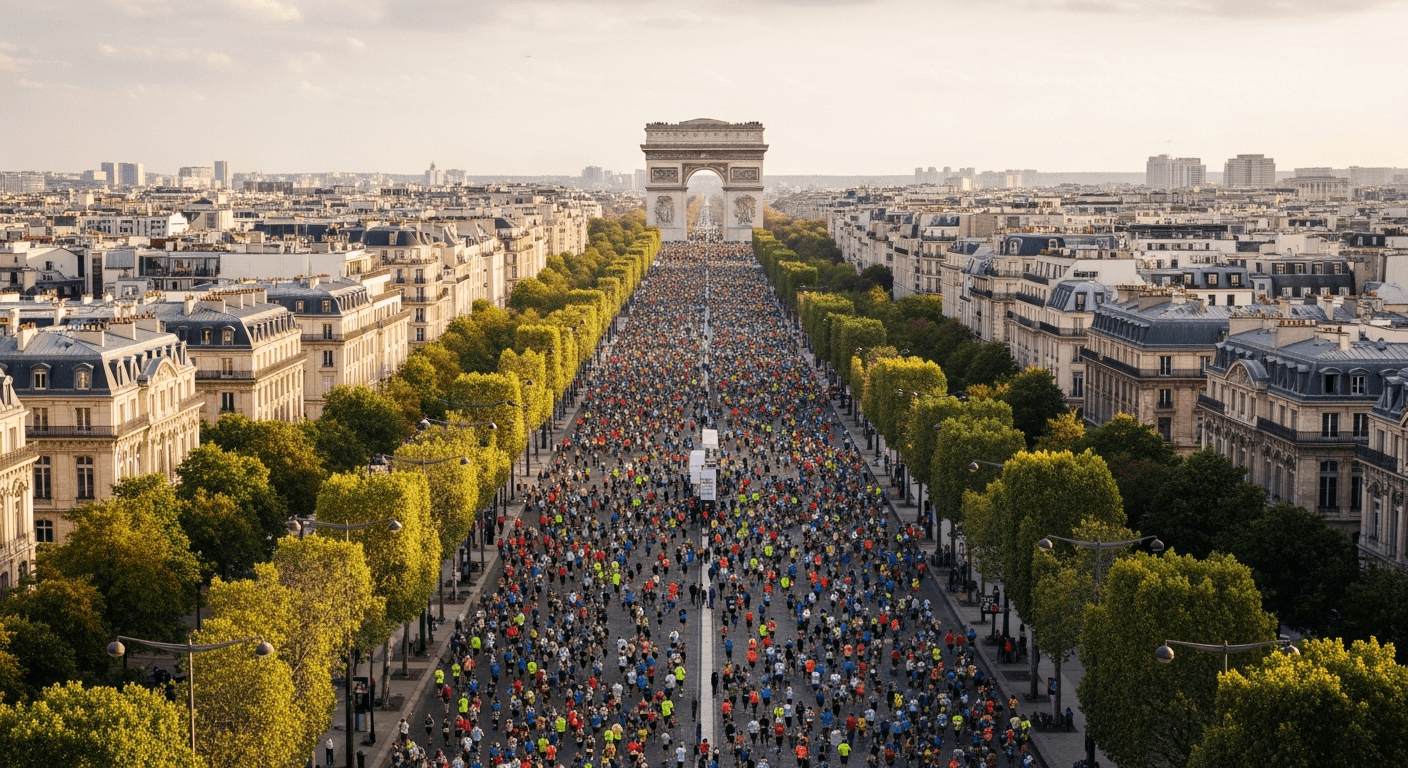
It's not often that a road race becomes the subject of heated political debate. But the Paris Marathon is not just any road race. With more than 50,000 runners crossing the start line each spring, it's one of the largest marathons on the planet. And right now, the question of who gets to run it. organizationally speaking. is a genuinely contested fight.
If you've registered for Paris, or you're thinking about it, what's happening behind the scenes matters more than you might expect. Entry fees, charity bibs, course design, elite race standards. all of it could shift depending on how this dispute resolves.
How the Paris Marathon Got Here
For decades, the Paris Marathon has been operated by Amaury Sport Organisation, better known as ASO. The same company that owns the Tour de France and Paris-Roubaix. ASO built the race into a global brand, attracting runners from more than 160 countries and generating an estimated $85 million or more in economic impact for the city each spring.
That arrangement has never been without tension. City officials have long had opinions about how the race is managed, how public spaces are used, and how the revenue is distributed. But those tensions, until recently, stayed largely behind closed doors.
What changed is a combination of factors. The 2024 Paris Olympics shifted how the city thinks about its sporting identity and infrastructure. Post-Games, the city's elected leadership has become far more assertive about which organizations should hold the rights to major events that use public streets, parks, and city resources. The Paris Marathon, which shuts down central Paris for an entire Sunday, is squarely in that conversation.
Who's Staking a Claim
There are three distinct camps in this dispute, and understanding each one helps explain why it's gotten complicated.
The city of Paris wants more control, or at least more formal oversight, over how the marathon is organized. City officials have raised questions about revenue sharing, community access, and whether the current operator aligns with Paris's broader goals around sustainability and public health. They've signaled interest in a model where the city holds greater authority over event standards.
ASO is not walking away quietly. The company has significant commercial infrastructure built around the Paris Marathon. sponsorship deals, timing systems, media rights, elite athlete contracts. Unwinding that would be expensive and complicated for everyone involved. ASO's position is essentially that it has built the race to global scale, and that institutional knowledge shouldn't be discarded.
Athletics federations, both national and international, have also entered the frame. There's a broader push globally for athletics governing bodies to have stronger oversight over city marathons, particularly around prize money standards, course certification, and doping controls. That pressure adds another layer to what's already a multi-sided negotiation.
Why 50,000 Runners Should Pay Attention
This might look like an internal squabble between French institutions. It isn't. The outcome will have direct, practical consequences for everyone who races Paris.
Start with entry fees. The Paris Marathon currently costs around $130 to $160 for general entry, which is competitive with major city marathons globally. The London Marathon sits in a similar range. New York and Chicago push closer to $280 to $350. If a new operator or a city-managed structure takes over, cost structures could shift in either direction. City-run events sometimes carry lower fees, but they also come with smaller operational budgets that can affect race-day quality.
Then there's the charity bib system. The Paris Marathon has a well-developed network of charity partnerships that allow runners to secure guaranteed entries in exchange for fundraising commitments. A change in organizer could restructure or eliminate those partnerships entirely, cutting off a meaningful route to entry for thousands of runners each year.
Course design is another variable. ASO has maintained a route that takes runners past the Louvre, through the Bois de Boulogne, and along the Seine. It's one of the most scenic marathon courses in the world. Any new organizing body would need city cooperation to preserve that route. and there's no guarantee the same course would survive a governance transition intact.
Elite race standards matter too. Paris has worked to attract world-class fields, and its status as an Abbott World Marathon Majors qualifier candidate has been discussed in running circles for years. A governance disruption could stall that ambition, or accelerate it, depending on who ends up in charge.
This Has Happened Before
Paris isn't the first major European city to go through this kind of dispute, and looking at comparable situations gives you a reasonable sense of how things might unfold.
The Berlin Marathon went through a significant organizational evolution before landing with SCC Events as its long-term operator, eventually becoming part of the World Marathon Majors series. The transition wasn't seamless, but it produced a race that now routinely sets world records and draws elite fields that are unmatched globally.
The Vienna City Marathon underwent a restructuring that brought the city government into a formal partnership role alongside the private operator. The result was a more stable funding model and stronger integration with city tourism infrastructure, though the transition took several years to settle.
Rome's marathon has struggled more. Multiple organizational changes over two decades left it with inconsistent quality and a diminished international profile. It's still a viable race, but it never achieved the global standing it once appeared to be heading toward.
The lesson across these examples is consistent. transitions that involve clear negotiated agreements between the city, the operator, and the relevant sporting bodies tend to produce better outcomes. Disputes that turn adversarial and drag into legal or political standoffs tend to hurt the race itself, sometimes permanently.
The Broader Shift in How Cities Think About Marathons
What's happening in Paris reflects a wider shift in how city governments are approaching major endurance events. After years of treating marathons primarily as tourism assets managed by private operators, cities are increasingly reasserting that these races represent public infrastructure in motion, using streets, police resources, medical services, and civic identity.
That framing has real implications. It means cities want seats at the table, not just licensing fees. It also means runners are increasingly caught between institutional interests that don't necessarily have runner experience as their primary concern.
The growth of alternative race formats has made this tension more visible. Events like HYROX have demonstrated that runners will migrate to new formats and new organizers if the traditional race experience stops delivering value. HYROX recently ran across six cities in a single weekend, a logistical feat that signals how aggressively newer event formats are scaling. City marathons can't assume loyalty is automatic.
For runners who have built training blocks and travel plans around races like Paris, organizational instability is a real inconvenience at best and a financial loss at worst. If you've paid for flights, hotels, and a race entry only to find the event reorganized or postponed, the cost is yours to absorb.
What Could Actually Change for You
If you're planning to run Paris in the next two to three years, here's what's worth watching.
- Entry fee trajectory. Watch whether prices shift significantly from current levels as the organizational structure clarifies. A jump above $200 would put Paris in a different competitive category globally.
- Charity entry availability. If you rely on a charity bib to secure your spot, monitor which organizations retain official partnership status through any transition period.
- Course certification status. Any governance change will require formal recertification of the course for record eligibility. That process takes time and creates uncertainty for elite runners and serious amateurs chasing personal records.
- Race-day logistics. Medical coverage, corrals, water stations, and finish-line infrastructure are all functions of the operator's budget and relationships. A transition year can mean gaps in these areas.
Training for a marathon is a months-long commitment. Understanding what race day actually looks like before you commit is always worth the research. That's doubly true when the race is in the middle of a governance dispute.
The Bigger Picture for Global Running
Paris matters because it's a bellwether. If the city successfully renegotiates control over a race of this scale and profile, other European capitals will watch closely. The same questions are simmering in multiple cities where long-standing private operators hold agreements that city governments are starting to scrutinize.
For runners, the ideal outcome is a stable race that gets better, not a race that spends years sorting out its own politics. The global running calendar is rich right now. Trail racing in particular is expanding rapidly, and runners who feel let down by major city marathons are finding compelling alternatives. That competitive pressure might ultimately be the best incentive for everyone involved in the Paris dispute to reach a workable agreement quickly.
The race draws people from every corner of the world. It deserves governance that treats that responsibility seriously. Whether it gets that depends on negotiations most runners will never see. But you'll feel the results every time you cross a start line in Paris.