
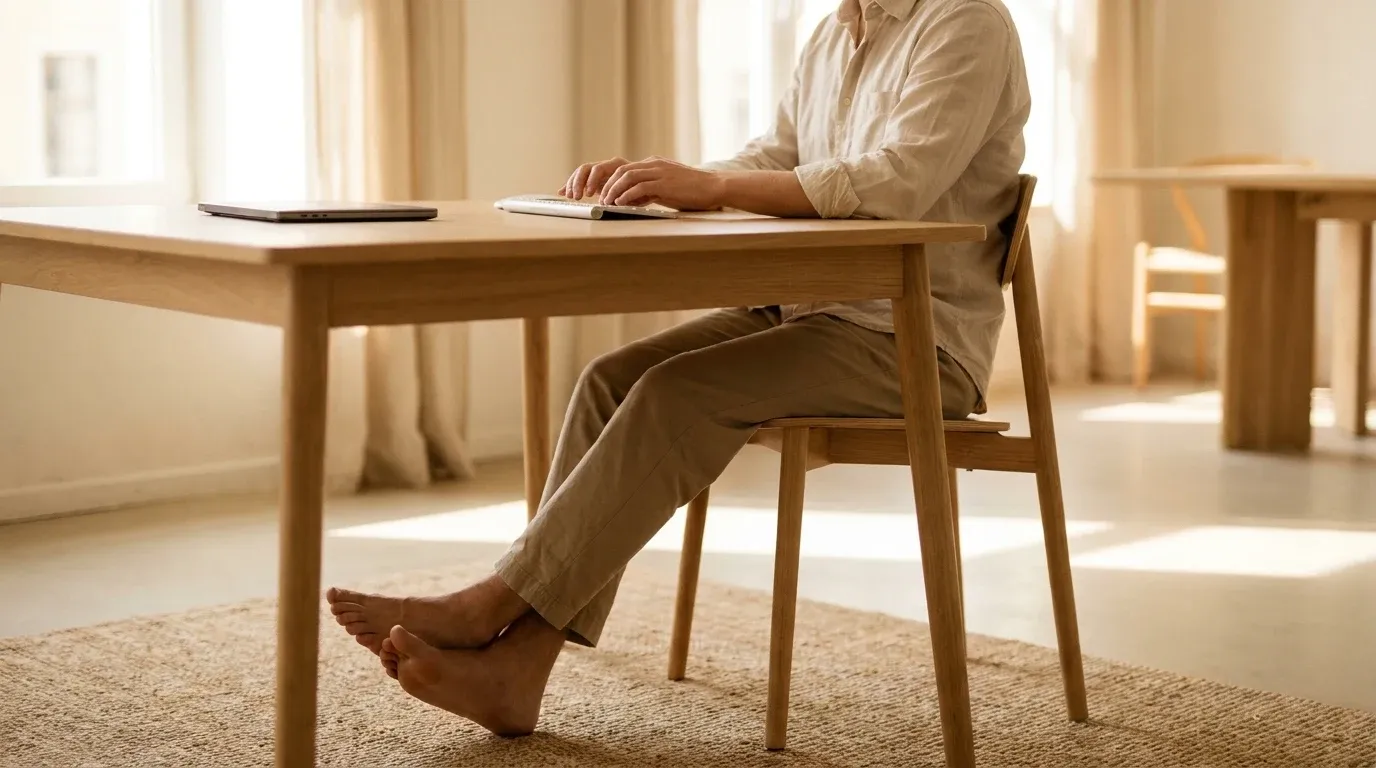
If you work at a desk, you've probably heard that sitting is bad for you. But the real story is more specific than that, and more actionable. Three studies published in the week of November 11–15, 2026 point to the same conclusion: it's not just how long you sit that hurts you. It's how you sit. Unbroken stretches of chair time carry risks that the same total hours, split into shorter segments, simply don't.
The good news is that the fixes are smaller than you think. No gym required. No midday run. Just a smarter pattern across your workday.
The Pattern Problem: Why Continuous Sitting Is Different
A November 13, 2026 Quartz review of sedentary work research draws a clear line between sitting a lot and sitting without breaks. The metabolic and mental health risks associated with desk work aren't simply a function of total hours. They're driven by how long you stay still in one stretch.
When you sit uninterrupted for extended periods, your body's glucose regulation slows, blood pools in the lower limbs, and the muscles that would otherwise act as metabolic engines go effectively offline. The review found that 60 to 75 minutes of moderate daily activity is what it takes to offset the harm from a sedentary workday. That's not a small ask, but it becomes more manageable when you understand that it doesn't have to happen all at once.
The mental health dimension matters too. 59% of workers say their jobs hurt their mental health monthly, and prolonged sedentary behavior is one of the contributing factors. Movement breaks don't just reset your body. They reset your focus and your mood.
Breaking your sitting into chunks, even imperfectly, changes the physiological picture. Your muscles re-engage. Circulation picks up. Blood sugar response improves. The pattern is the intervention.
Chair Aerobics: Low Cost, No Equipment, Real Results
A November 15, 2026 study published in the International Journal of Innovative Research and Development found that a 12-week structured chair aerobics program produced significant improvements in physical activity levels and flexibility among desk-bound women. The participants didn't leave their workstations for a gym session. They moved in and around their chairs, using bodyweight and controlled motion.
The results held up across flexibility markers and self-reported activity levels, and the program required no equipment and minimal cost. That's a meaningful finding for anyone working in an office environment where committing to a formal exercise class during the day isn't realistic.
Chair aerobics typically include seated leg raises, torso rotations, shoulder rolls, ankle circles, and seated marching. Done consistently across a workweek, they accumulate enough movement to shift your baseline. The structured nature of the 12-week program mattered, too. It wasn't sporadic. It was scheduled, which is part of why it worked.
If you're already thinking about how movement integrates with broader recovery strategies, it's worth reading about active vs. passive recovery and which approach fits your workload. What counts as active recovery at a desk job might look different from what you'd expect after a training session, but the principle is the same: low-intensity movement supports restoration.
The Soleus Push-Up: One Muscle Doing a Lot of Work
A November 13, 2026 report from Tom's Guide brought renewed attention to the soleus push-up, a small exercise with an outsized physiological effect. The soleus is the deeper of the two main calf muscles, and it has an unusual property: it can sustain low-level contractions for long periods without fatiguing the way larger muscle groups do.
When activated, the soleus acts as a secondary circulatory pump. It supports venous return, which is the process of pushing blood from the lower limbs back up toward the heart. During prolonged sitting, that process slows dramatically, which contributes to swelling, heaviness in the legs, and increased cardiovascular strain over time.
The soleus push-up is performed seated. You keep your foot flat on the floor, raise your heel while the ball of your foot stays grounded, then lower it back down in a slow, controlled rhythm. It doesn't look like much. But the research suggests it triggers a meaningful metabolic and circulatory response, reducing lower-limb strain without requiring you to stand up or leave your desk.
Strong posterior chain muscles don't just serve athletic performance. They support the basic demands of a sedentary workday. If you want to build that foundation more deliberately, adding explosive moves to your lifting routine can reinforce the lower-body strength that keeps desk work from accumulating into chronic strain.
The 20-8-2 Protocol: A Framework You Can Actually Follow
Research covered on November 11, 2026, drawing on the work of ergonomics researcher Dr. Mark Benden, proposes a structured daily rhythm for desk workers: 20 minutes sitting, 8 minutes standing, 2 minutes walking, repeated throughout the workday. The 20-8-2 protocol isn't a vague suggestion to move more. It's a timed cycle designed to match how long most people can stay in any one position before the physiological costs start compounding.
The data behind it is specific. Workers who used height-adjustable desks as part of a structured protocol logged an average of 43 additional minutes of productive computer use per day compared to those using fixed-height desks. That's counterintuitive but consistent with what researchers know about how movement affects cognitive performance. Standing and walking intervals don't pull you out of productive work. They support it.
Practically, the 20-8-2 cycle works best when it's automated. A phone timer, a desktop app, or a wearable that prompts you to shift position removes the cognitive load of tracking it yourself. The challenge isn't remembering the protocol once. It's making it automatic enough that it survives a busy afternoon.
This kind of structured approach to daily movement also connects to broader questions about mobility maintenance. If you're unsure how much dedicated mobility work you actually need on top of your workday movement, the answer depends on factors most people overlook.
What These Studies Say Together
Taken individually, each of these findings is useful. Taken together, they build a coherent picture of what desk workers actually need.
- Pattern matters more than total hours. Breaking up sitting into shorter chunks reduces metabolic and mental health risk more effectively than simply trying to cut total sitting time.
- Small, seated exercises produce real results. Chair aerobics and soleus push-ups require no equipment, no gym access, and no time away from your desk. Done consistently, they improve flexibility, circulation, and lower-limb health.
- Structured protocols outperform vague intentions. The 20-8-2 framework works because it's specific. It gives you a cycle to follow, not just a general nudge to sit less.
- The threshold for meaningful change is reachable. Sixty to 75 minutes of moderate daily activity sounds like a lot, but across a full workday, micro-breaks and low-intensity movement accumulate faster than you'd expect.
None of this replaces structured training outside of work. If you're trying to understand whether your off-hours exercise is doing enough, the comparison between doing HIIT once versus three times a week gives you a clearer sense of what frequency actually changes in terms of VO2 max and fat loss outcomes. Desk-based movement and planned exercise serve different functions, and both matter.
Building the Habit Without Overhauling Your Day
The practical barrier to most of these interventions isn't knowledge. It's execution. You know you should move more. The question is how to make it happen consistently when your calendar is full and your focus is stretched.
Start with one anchor habit. The soleus push-up is a good entry point because it requires nothing: no standing, no walking, no visible disruption to a meeting or call. Practice it during video calls or while reading. Once it's automatic, add a standing interval using the 20-8-2 structure. Then introduce a short chair aerobics sequence at a fixed point in your day, the same time every day, until it becomes as routine as making coffee.
The research on sedentary work has become clear enough that the question is no longer whether to act. It's how to build systems that make action the default. The interventions exist. The evidence supports them. What's left is making the pattern stick.