
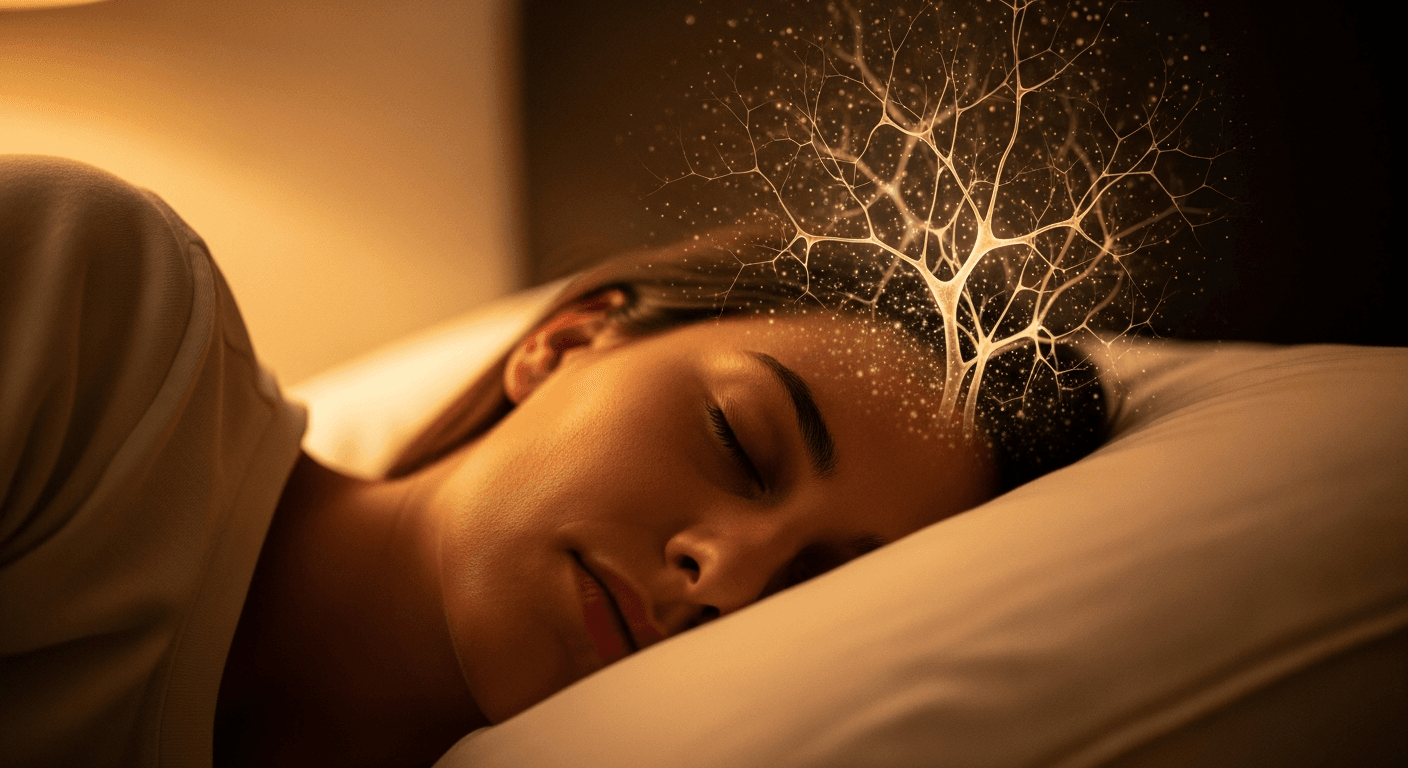
Most people treat sleep as a single, uniform event. You close your eyes, you rest, you wake up. But the final hours of your night are doing something your waking brain never could: generating a full simulation of movement and prediction, entirely from scratch, with zero input from the outside world.
New research from the Howard Hughes Medical Institute has made that process visible in a way it never has been before. And what it reveals changes how you should think about sleep quality, not just sleep quantity.
Your Motor Cortex Is Still Giving Orders
Here's the detail that changes everything. During REM sleep, your body is essentially paralyzed. Signals from your brainstem actively suppress muscle movement so you don't act out your dreams. That part has been understood for decades.
What the HHMI researchers discovered is that your motor cortex, the region of the brain responsible for directing physical movement, keeps sending head-movement commands throughout REM sleep. The commands go out. The body just doesn't execute them. The motor system is fully active, rehearsing movement patterns in a vacuum, completely independent of any physical reality.
This isn't residual noise or a quirk of brain chemistry. It appears to be a structured, functional process. The motor cortex isn't idling. It's working.
REM Sleep Is Active Processing, Not Passive Recovery
The long-standing popular image of sleep as the brain "powering down" has always been incomplete. But this research makes the active nature of REM impossible to ignore.
During REM, your brain is generating information internally rather than receiving it externally. There's no sensory input driving the activity. No light, no sound, no physical sensation. The brain builds its own signal, runs it through motor and perceptual circuits, and processes the output as though it were real.
This is sometimes called an internally generated predictive model. Your brain isn't replaying memories passively. It's stress-testing its own predictions. It's running simulations of how movement, perception, and response are supposed to work, and updating its internal map accordingly.
The practical consequence of that process is significant. When REM sleep is cut short or disrupted, you're not just losing rest. You're losing the recalibration session your brain depends on to stay accurate.
What Happens When You Skip the Rehearsal
The downstream effects of poor REM quality are well-documented across sleep science. Reaction time slows. Decision-making under pressure becomes less precise. Emotional regulation deteriorates, meaning everyday stress hits harder and lingers longer.
These aren't vague, hard-to-measure outcomes. Studies using standardized cognitive testing consistently show that REM-deprived subjects perform worse on tasks requiring rapid assessment and flexible thinking, even when total sleep duration looks adequate on paper.
That last point matters. You can sleep eight hours and still underperform if those hours are weighted toward light or deep sleep at the expense of REM. The question isn't only how long you sleep. It's what your brain gets to do during that time.
If you're training seriously, this connects directly to performance. The same motor circuits that rehearse movement during REM are the ones you depend on for coordination, timing, and technical execution in the gym or on the field. Disrupted REM means those circuits are working with an outdated map. For anyone building a structured program, a balanced fitness routine that accounts for recovery quality isn't optional. It's part of the physiological equation.
Why REM Is Concentrated Where You're Most Likely to Cut Sleep Short
Here's where the research has a direct, practical implication that most people miss entirely.
REM sleep doesn't distribute evenly across the night. It concentrates in the final sleep cycles. A typical night moves through cycles of roughly 90 minutes each, with each successive cycle containing a longer REM phase. The first cycle might include only 10 minutes of REM. The final cycle before you wake can include 45 to 60 minutes.
That means the last 90 minutes of your sleep are disproportionately valuable for brain function. And that's exactly the window most people sacrifice when an alarm goes off early, when a late night shortens the sleep window, or when alcohol disrupts the architecture of the final cycles.
Alcohol is worth pausing on here. It's widely known to help people fall asleep faster. What's less understood is that it suppresses REM sleep significantly, particularly in the second half of the night. A nightcap doesn't give you better sleep. It gives you more of the kind of sleep that doesn't serve your brain's maintenance needs.
The Predictive Brain and Why This Goes Beyond Sleep Science
The HHMI findings connect to a broader model of how the brain operates called predictive processing. Under this framework, your brain doesn't simply react to the world. It constantly generates predictions about what's coming, then updates those predictions based on incoming evidence.
REM sleep, under this model, is when the brain runs its predictions without any real-world feedback at all. It's essentially a nightly audit of your perceptual and motor models. The brain asks: do my internal simulations still match what I expect to experience? Then it adjusts.
When that process is disrupted regularly, the predictions get stale. Your brain becomes slightly less accurate at anticipating what's about to happen, which is why the cognitive and emotional costs of poor REM compound over time rather than staying flat.
This also connects to stress regulation in a way that's easy to underestimate. The relationship between deep rest and stress response is well-established, but REM's role specifically is about recalibrating threat perception. When your brain hasn't had the chance to run its internal simulations, it tends to treat ambiguous situations as more threatening than they are. That's not a psychological weakness. It's a physiological miscalibration.
What You Can Actually Do About It
Protecting REM sleep requires a slightly different mindset than most sleep advice suggests. The standard recommendations around consistency and environment are still valid. But the REM-specific angle adds some priorities.
- Prioritize your sleep window's end, not just its start. Going to bed earlier matters less than not cutting the morning short. If you have to choose between an earlier bedtime and a later alarm, the later alarm preserves more REM.
- Treat alcohol as a sleep disruptor, not a sleep aid. Even moderate evening drinking shifts sleep architecture away from REM. If recovery quality matters to your training, that trade-off is worth understanding clearly.
- Watch what happens to your sleep before early events. Anxiety about an early alarm, a race, or a morning commitment activates light sleep and can fragment the final REM cycles significantly. This is one reason pre-competition sleep is often reported as poor even by experienced athletes.
- Consider what your evening routine is doing to your final sleep cycles. Late-night screen exposure, stress, or heavy training close to bedtime all have documented effects on REM architecture. Recovery isn't just about what you do after exercise. The gaps in most recovery routines tend to show up in exactly this kind of sleep quality data.
- Look at total sleep opportunity, not just time in bed. If you're consistently getting less than seven and a half hours, you're almost certainly shortchanging your REM phases regardless of sleep hygiene. The math doesn't work below that threshold for most adults.
Sleep Duration and Sleep Architecture Are Two Different Problems
This distinction is worth making explicit because most public health messaging conflates them. When experts say "get eight hours," the implicit assumption is that eight hours of normal sleep architecture will follow. For many people, that assumption is wrong.
Poor sleep architecture, meaning too little REM relative to total sleep time, can occur even with adequate duration. Chronic stress, certain medications, alcohol, sleep apnea, and inconsistent sleep timing can all shift the proportion of REM downward without necessarily reducing the total hours you're asleep.
If you're sleeping enough but still waking up cognitively flat, struggling with mood regulation, or noticing that your reaction time in training feels slower than it should, sleep architecture is a reasonable place to investigate. A sleep tracker with REM detection isn't a perfect tool, but it gives you a directional signal worth paying attention to.
The other piece worth considering is that brain function during sleep doesn't operate in isolation from what you're doing during the day. Nutrition, training load, and stress levels all affect sleep quality bidirectionally. How and when you're consuming protein has documented effects on overnight recovery, including on sleep quality metrics that feed directly into REM duration.
The Bigger Picture
The HHMI research matters because it shifts the frame on what sleep is actually for. It's not primarily a recovery state where the body repairs itself while the brain goes quiet. It's an active construction process. Your brain is building, testing, and refining the models it uses to navigate the world, every single night, in the hours you're most likely to sacrifice.
The motor cortex firing head-movement commands into a paralyzed body isn't a curiosity. It's evidence of a system that treats rehearsal as non-negotiable, even when the body can't follow through. Your waking performance is partly a reflection of how well that system got to do its job the night before.
Sleep longer when you can. But more specifically: protect the end of your sleep. That's where the work happens.