
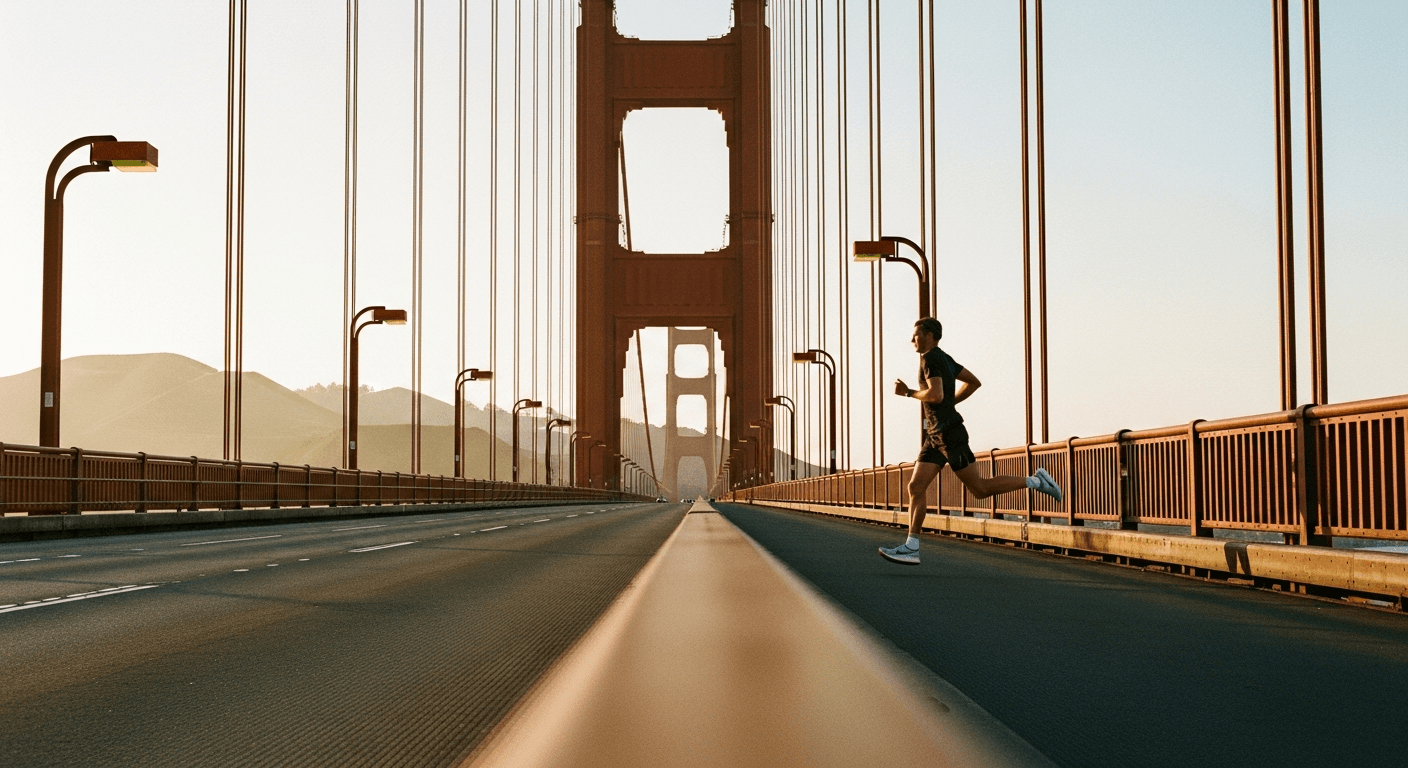
Why the SF Marathon is in a category of its own
The San Francisco Marathon is one of the few urban marathons where you cross the Golden Gate Bridge at dawn. Held every year on the last Sunday in July — July 27, 2026 — it brings together around 30,000 participants across 26.2 miles of the city's most iconic terrain.
But let's be clear: this isn't a PR course. With 1,100+ feet of elevation gain, sneaky climbs through Haight-Ashbury, and weather that swings between fog and coastal wind, San Francisco is a character course. You run it for the experience. For the views. For the story of crossing the Golden Gate on foot. If you're chasing a fast time instead, the BMW Berlin Marathon's flat course is worth a look.
The course breakdown
Start time is 5:30 AM on Howard Street in SoMa. The early start isn't just logistical — San Francisco in July mornings are cool and often foggy. Running at 5:30 also means finishing before the heat rises and traffic locks down the city.
The first miles run along the Embarcadero and the historic waterfront. It's flat, fast, and spectacular with bay views. You pass Fisherman's Wharf before climbing toward the Golden Gate Bridge — the moment everyone's been waiting for.
Crossing the Golden Gate Bridge is the defining moment of the race. You cross it both ways — out toward Marin, back into San Francisco — with views of the bay, the city skyline, and the Pacific. Depending on conditions, you're in fog or watching a sunrise. Both are unforgettable.
After the bridge, the course heads south through Golden Gate Park — a long, wooded stretch that offers welcome relief before the Haight-Ashbury climbs. The course finishes back at the Embarcadero for a waterfront final stretch.
Elevation profile
The course climbs and descends multiple times. The key difficulty sections:
- Miles 5-8: climb to the Golden Gate Bridge from the Marina District
- Miles 14-16: climbs through Haight-Ashbury after Golden Gate Park
- Miles 19-22: rolling false flats in the south neighborhoods
Total elevation gain: 1,100+ feet. That may sound manageable, but in a marathon, every climb in the second half hits harder than it looks on paper.
SF-specific prep tips
Train the hills. If your long runs are all flat, the SF course will punish you in miles 14-22. Add hill repeats and gain-heavy long runs to your build-up. Dress in light layers. SF in July at 5:30 AM can be 55-60°F with wind and fog, then climb to 65°F by 9 AM. A light wind layer you can tie around your waist once warm is the standard move. Go out slower than you feel. The flat first miles feel fast and easy. Save energy for the bridge climb and the Haight-Ashbury section in the middle of the race. It's also worth understanding how elite runners balance heart rate and pace on hilly courses — effort-based training translates directly to a route like this.
Logistics essentials
Start from SoMa (Howard Street). Finish at The Embarcadero — you end a few hundred meters from the start, which simplifies logistics. Muni and BART run early for pre-race transport. Registrations typically open in November of the previous year and sell out fast, especially for full Golden Gate Bridge crossing bibs (limited allocation). For a full breakdown of expo dates, bib pickup, and race weekend timing, the San Francisco Marathon 2026 race guide covers everything you need before July 27.