
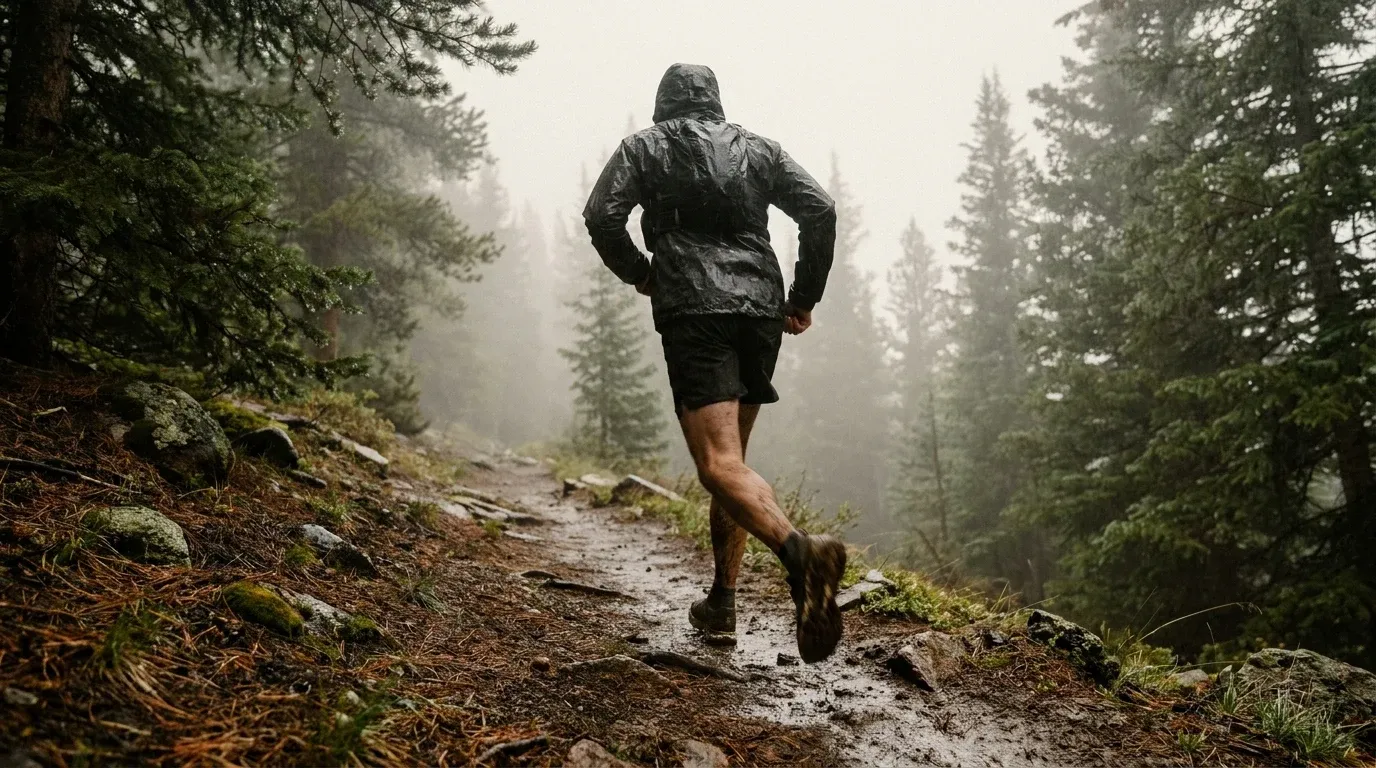
Some race days are defined by perfect conditions. Steamboat Springs delivered the opposite on September 21, 2026. Rain soaked the trails, the course churned into something unpredictable, and two athletes went out and ran faster than anyone ever had at the Run Rabbit Run 100 Mile. Both of them. On the same day.
Ryan Sullivan and Hannah Allgood didn't just win their respective races. They rewrote what this course is capable of producing, and they did it in conditions that would have given most runners a legitimate excuse to back off the pace.
Sullivan's Record: Nearly 19 Minutes Faster Than Anyone Before Him
Ryan Sullivan crossed the finish line in 17 hours, 3 minutes, and 38 seconds, taking nearly 19 minutes off the previous men's course record at Run Rabbit Run. That's not a marginal improvement. That's a statement about where men's 100-mile racing is headed right now.
For context, shaving 19 minutes off a course record at this distance is roughly equivalent to running two full bonus miles at race pace. It signals that Sullivan didn't just have a good day. He had the kind of day that resets expectations for every runner who lines up in Steamboat in the years ahead.
The Run Rabbit Run 100 covers approximately 102 miles through the mountains around Steamboat Springs, Colorado, with over 20,000 feet of elevation gain. It's a course that punishes pacing mistakes and rewards runners who stay composed through the night sections and into the brutal final stretch. To break the record here, in the rain, suggests Sullivan was executing close to a perfect race.
Allgood's Record: A Women's Performance to Match the Moment
Hannah Allgood set a new women's course record on the same day, completing a double that race directors and statisticians rarely get to document. The precise margin of her record improvement underscores the depth she brought to the course. Like Sullivan, she was running in conditions that would have been a reasonable explanation for slower times. She chose a different response.
Allgood's performance adds another chapter to what has been a strong year for women in ultra-distance trail racing. The field at elite 100-mile events has been deepening steadily, and results like this one suggest the ceiling is still a long way up. If you've been following the rise of trail running talent this year, you'll recognize this as part of a broader pattern. Maya Rayle's emergence as one of trail running's newest elite voices is another signal that the sport is producing exceptional athletes at a rate that's accelerating.
What Rain Actually Does to a 100-Mile Course
It's easy to hear "rainy conditions" and imagine mild inconvenience. At the 100-mile distance, rain changes the race in fundamental ways.
- Footing becomes unreliable. Technical descents that runners can push hard in dry conditions require significantly more caution when wet. Every section of trail with exposed rock or loose dirt becomes a liability.
- Energy expenditure increases. Maintaining traction on wet surfaces requires more muscular engagement per stride. Over 100 miles, that adds up to meaningful additional fatigue.
- Mental load compounds. Rain sustained over many hours tests concentration in a way that clear conditions don't. You're constantly adjusting, monitoring, managing risk alongside pace and nutrition.
- Gear and temperature management become active problems. Wet clothing loses insulating properties. Night sections get colder. Crew and pacer logistics become more complex.
Breaking a course record despite all of this is a different kind of achievement than breaking one on a dry, fast day. It suggests both Sullivan and Allgood had not only the physical capacity for record-breaking performances, but the mental framework to execute under pressure. That kind of composure is a trained skill, not a personality trait. Preparing mentally for a fall race is something every endurance athlete should be working on well before race week arrives.
A Double Record at a Single Race: Why It Matters
Having both the men's and women's course records fall on the same day at the same race is statistically uncommon. It happens occasionally in road marathons when conditions align and fields are stacked. In 100-mile trail racing, where variables are far more complex and fields are smaller, it's genuinely rare.
When it does happen, it tends to indicate one of a few things: a course that was measured or designed in a way that allows records to compound over time as the field deepens, a particular year when training methods have advanced to a level that produces faster athletes across the board, or a race that has built the kind of competitive infrastructure that attracts record-caliber runners.
Run Rabbit Run has been building that reputation for years. It draws serious athletes who've done the preparation. Nailing nutrition in the week before race day is one piece of that preparation. Training volume, course-specific work, and recovery management are others. The runners who show up at events like this have typically left nothing to chance.
The double record is also a reflection of what's happening across ultra-endurance sport more broadly. Marathon participation is breaking records in 2026, and the pipeline of talent flowing into longer distances is stronger than it's been in decades. More runners are doing more serious training, and some of them are arriving at 100-mile races prepared to run fast.
The Physiology of Going Faster at This Distance
What separates a record-breaking 100-mile performance from a strong finish is worth understanding, even if you're not planning to run 100 miles yourself.
At this distance, the competition isn't just between athletes. It's between each runner and their body's ability to maintain output over a time frame that most people associate with sleep, not sport. Metabolic efficiency, the ability to process fat as fuel at race pace, becomes critical. So does the capacity to keep moving decisively through the low points that every runner experiences between hours 12 and 20.
Elite 100-mile runners train in ways that look different from marathon preparation. Long back-to-back efforts, time on feet over technical terrain, and targeted strength work all play a role. The specificity of preparation for events like Run Rabbit Run is one reason why record-breaking performances don't happen by accident. They're the product of months of deliberate, well-structured work.
There's also a recovery dimension that casual observers often underestimate. The athletes who perform at this level understand that more training volume doesn't automatically produce better results. The relationship between training load and performance has real limits, and managing those limits intelligently is part of what separates athletes who peak on race day from those who arrive fatigued.
What This Means for the Fall Ultra Season
The Run Rabbit Run double record lands at a moment when the fall ultra season is already producing compelling results. The depth of competition in 100-mile racing is visibly increasing, and race results from 2026 are tracking ahead of previous years in terms of finishing times at the front of the field.
For athletes preparing their own long-distance goals, the lesson from Steamboat Springs on September 21 isn't that you need to be Sullivan or Allgood. It's that conditions don't have to dictate outcomes. Rain, mud, cold, and technical terrain are problems to be managed, not reasons to abandon the plan. Both record-breakers showed that the right preparation makes the external variables smaller.
If you're building toward your own fall race or thinking about stepping up to longer distances, what happened at Run Rabbit Run is worth sitting with. Two athletes ran the best performances in the history of a competitive 100-mile race, in conditions that were actively working against them. That's not luck. That's the result of showing up ready.
The 2026 fall ultra season has several more major events ahead, and results like this one raise the question of where the records will fall next. The athletes capable of answering that question are already out there training. Some of them are probably running in the rain right now.