
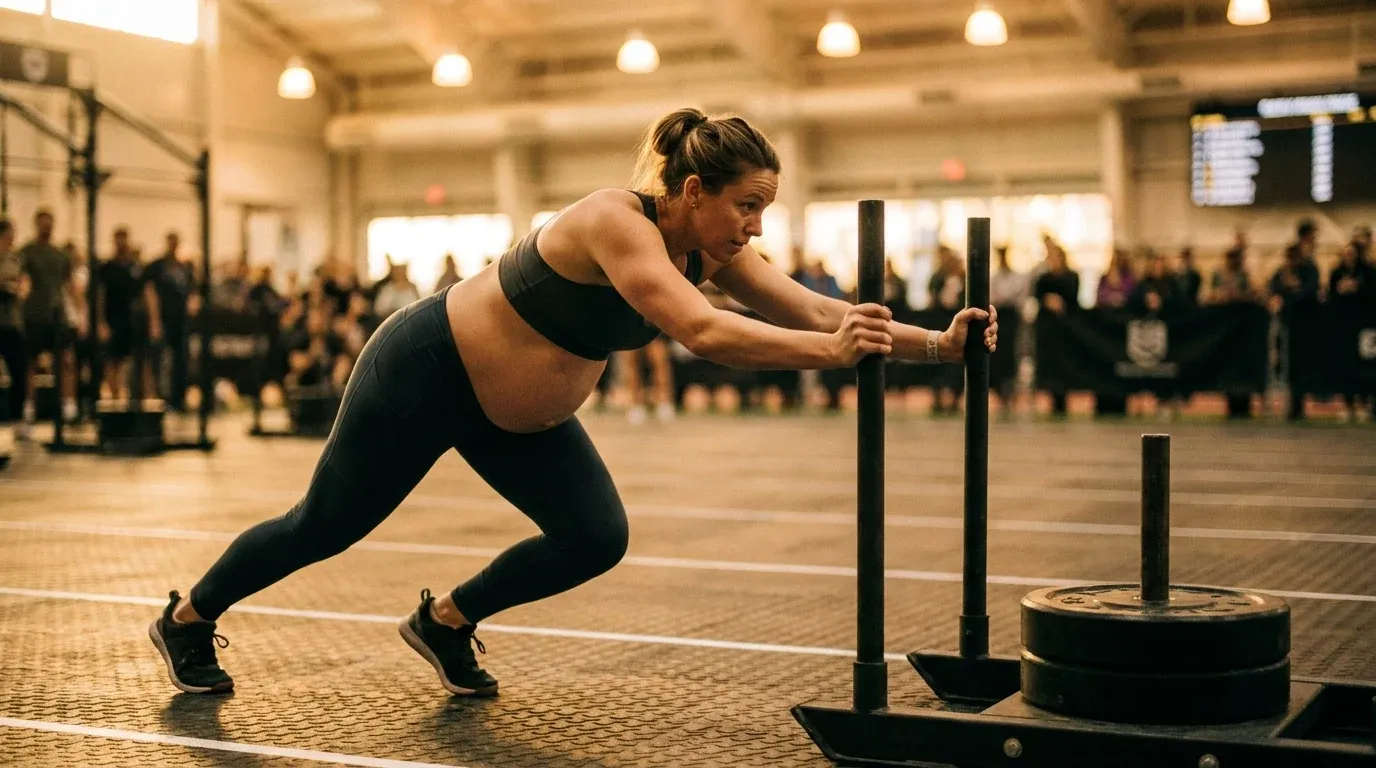
Jenneec is HYROX's regional race director for China. She knows the format inside out. She has watched thousands of athletes cross finish lines, push through sled stations, and fight through the final SkiErg pull. So when she lined up at a HYROX event in Japan at seven months pregnant, she wasn't doing it on a whim. She was making a deliberate choice, backed by body knowledge and competitive experience.
The story spread fast. Images and accounts of her race circulated across social media, drawing reactions that ranged from awe to concern to pointed debate. That friction is worth examining. Because what Jenneec did isn't just a human-interest moment. It reframes something fundamental about what HYROX actually is and who it's built for.
What Actually Happened in Japan
Jenneec competed in the mixed-doubles format, which pairs one male and one female athlete who alternate through the running and workout stations together. It's not a solo grind. The structure allows effort to be distributed, pacing to be collaborative, and intensity to be modulated in ways a solo race simply doesn't permit.
At seven months pregnant, she completed the full event. She didn't drop out. She didn't need medical intervention. She finished. Her partner carried a larger share of the heavier load where needed, and the format's built-in flexibility made that possible without violating any rules or compromising the competitive integrity of the race.
HYROX's mixed-doubles category exists precisely because the sport is designed to meet athletes at different points in their fitness journey. That's not a weakness in the format. It's the architecture working as intended.
The Debate That Followed
Any story involving pregnancy and physical exertion is going to pull opinions in multiple directions. That's predictable. What's more interesting is the quality of the conversation Jenneec's race sparked.
On one side, critics raised safety concerns. Third trimester physical competition carries real physiological considerations. Core pressure, cardiovascular load, fall risk, and heat regulation all shift significantly by month seven. These aren't dismissible points. They're legitimate variables that any pregnant athlete needs to evaluate carefully, ideally alongside an OB-GYN or sports medicine physician familiar with their individual case.
On the other side, advocates for athletic autonomy pushed back hard. Research consistently shows that moderate-to-vigorous exercise during low-risk pregnancies is not only safe but beneficial. It's associated with reduced rates of gestational diabetes, lower incidence of excessive weight gain, and improved postpartum recovery. The American College of Obstetricians and Gynecologists supports continued exercise through pregnancy for women without contraindications.
The nuance here matters. "Pregnant" is not a single category. A sedentary person in their seventh month and a seasoned fitness professional with years of structured training are not the same athlete. Jenneec's baseline, her professional familiarity with the sport, and her proximity to medical resources at a sanctioned event all factor into the picture in ways that a two-sentence social media reaction rarely captures.
Why the Mixed-Doubles Format Changes the Calculus
HYROX events offer several competitive categories: Open, Pro, Singles, Doubles, and Mixed Doubles. Each carries different expectations around load and pace. The mixed-doubles format is where this story gets particularly interesting from a structural standpoint.
In mixed doubles, athletes tag in and out across the running loops and share the workout stations. Partners can choose how to divide repetitions, which means one athlete can take on more volume during demanding stations like the Sled Push or Burpee Broad Jumps while the other maintains movement at a lower output. It's not cheating the format. It's using it correctly.
For a seven-months-pregnant athlete, this creates a meaningful window. The high-impact, high-load moments that would pose the greatest risk in a solo format become negotiable. The running portions can be kept at a controlled aerobic pace. The shared stations allow effort distribution that a traditional competitive format simply wouldn't accommodate.
This is the kind of structural flexibility that makes HYROX genuinely different from most competitive fitness events. You don't need to be chasing a podium to participate meaningfully. That design choice has consequences. One of them is that it creates space for athletes like Jenneec to stay connected to their sport during life stages that would otherwise force a complete exit.
Athletic Identity Doesn't Pause for Pregnancy
This is the undercurrent of the entire conversation. For serious athletes, the loss of competitive participation during pregnancy isn't just physical. It's psychological. Identity, routine, community, and self-concept are all tied to showing up and doing the work. Telling a competitive athlete to simply stop for nine months ignores that dimension entirely.
Jenneec's choice to race wasn't reckless. It was an assertion of continuity. She remained who she is, a fitness professional and competitive athlete, while navigating one of the most physically transformative experiences a human body can undergo. Those two things don't have to cancel each other out.
The conversation around athletic participation during pregnancy has been shifting for years. High-profile cases, from marathon runners to Olympic athletes who have competed while pregnant or returned to elite competition shortly after birth, have gradually moved the needle on what the public accepts as possible. Jenneec's story adds a new layer: not an elite champion pushing records, but a working professional in the fitness industry choosing to remain in the arena on her own terms.
What This Tells You About HYROX's Reach
HYROX has grown aggressively across Asia-Pacific in recent years. Japan has become a key market, with events drawing large fields and strong regional engagement. The brand's expansion into China, where Jenneec serves as regional race director, reflects the same pattern: a format that translates across cultures because it's built on universal physical principles rather than niche athletic subcultures.
That growth depends on the sport maintaining its appeal to athletes who aren't chasing professional contracts. The bulk of any HYROX field is recreational. People who work full-time, train around family obligations, manage injuries, and show up anyway. Jenneec's participation is a visible extension of that community, not an outlier from it.
If you're someone who's used HYROX as a goal-setting anchor, whether for your first race or your fifteenth, her story is a reminder that the format has more range than the highlight clips suggest. It's not just a proving ground for athletes with six-figure VO2 max scores and sixteen-hour training weeks. It's a structured, measurable event that rewards showing up.
Preparation still matters at every level. Getting your race-day logistics right, your fueling dialed in, and your taper correct are the fundamentals that apply whether you're eight weeks postpartum or seven months pregnant. The framework in Trail Race Week: Your Complete Checklist for Race-Day Readiness applies cleanly to HYROX event week as well, particularly around hydration and sleep in the days before.
Nutrition becomes especially consequential during pregnancy-adjacent training. Mineral status shifts significantly, and sweat losses compound those deficits faster than most athletes expect. The research behind Why Your Minerals Drop Every Fall (And What to Do) is relevant year-round for any athlete managing higher-than-average physiological demand.
Where the Limits Actually Are
This story doesn't argue that every pregnant athlete should race. It doesn't argue that all competitive formats are safe for all pregnant bodies. It argues something narrower and more useful: that blanket exclusion and blanket permission are both lazy responses to a complex question.
The real answer requires individualization. What's your training history? What does your physician say? What format are you entering? What's your honest assessment of your body's current capacity? Jenneec had clear answers to those questions. Other athletes will have different answers, and some of those answers will point toward sitting out. That's not failure. That's accurate self-assessment.
HYROX as a sport benefits from conversations like this one. Not because pregnancy racing should become a marketing angle, but because the debate exposes something true about the format: it's more accommodating than it looks from the outside, and it draws athletes from a wider spectrum of life circumstances than most competitive fitness brands acknowledge.
For anyone tracking their supplement stack during high-output training blocks, including those navigating pregnancy-adjacent fitness, the evidence base matters more than marketing claims. How to Actually Evaluate Supplement Evidence gives you a practical framework for cutting through noise and making decisions grounded in data rather than branding.
Jenneec finished her race. She crossed the line. She went home. And the conversation she sparked is more useful than any result she could have logged on a leaderboard, because it forced a global fitness audience to ask a harder question than "how fast." It forced the question of who gets to compete, and on whose terms. The answer, at least in the context of HYROX and its mixed-doubles format, is broader than most people assumed.