
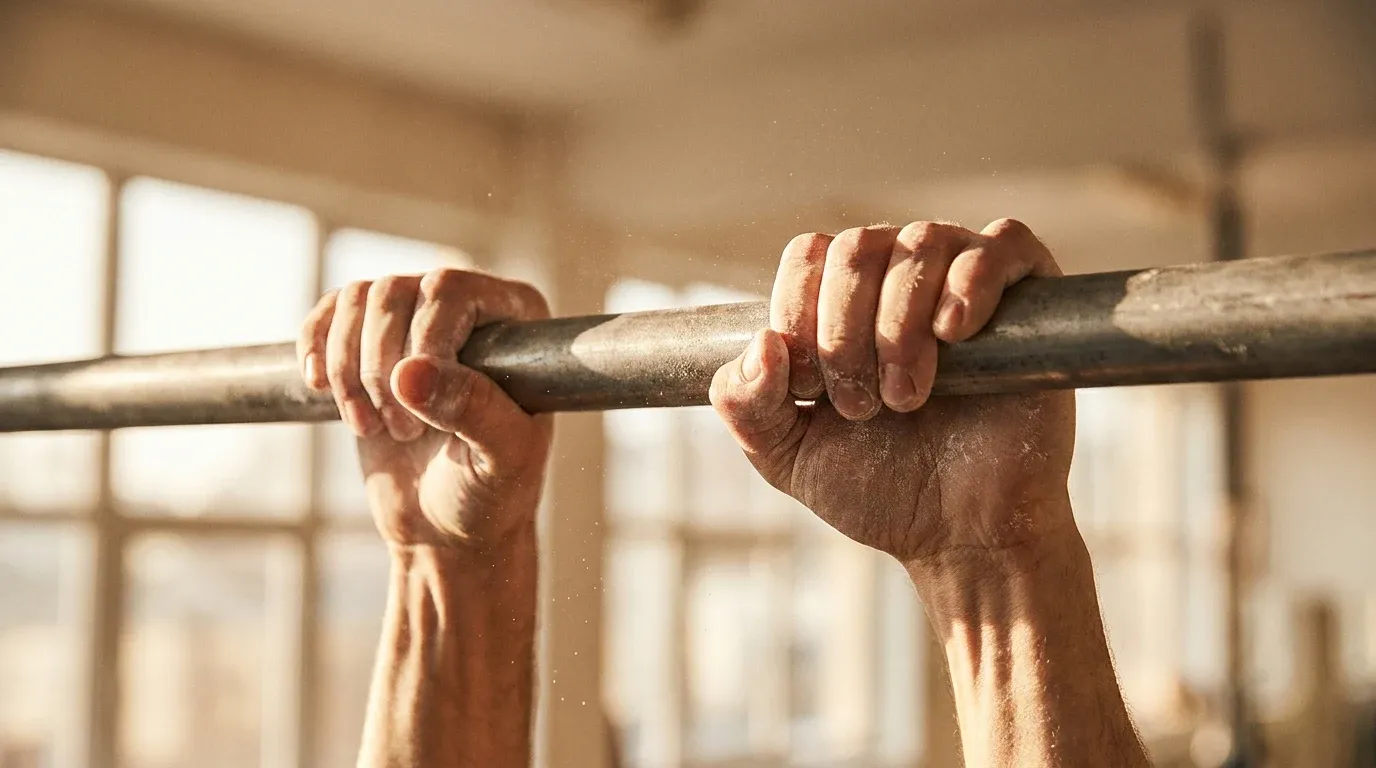
You track your deadlift numbers, your bench press, maybe your mile time. But there's one metric sitting at the intersection of muscular health, cardiovascular fitness, and neurological function that most lifters completely ignore. It fits in your gym bag, costs less than a post-workout meal, and according to a growing stack of large-scale research, it may be one of the most honest signals your body sends about how long you'll actually live.
That metric is grip strength. And the science behind it is harder to dismiss every year.
Why Researchers Keep Coming Back to Grip Strength
Grip strength has emerged as one of the most studied biomarkers in longevity research, not because scientists are obsessed with handshakes, but because it turns out to be a surprisingly clean window into whole-body health. It reflects the integrated output of your musculoskeletal system, your nervous system's ability to recruit motor units, and your cardiovascular system's capacity to support sustained muscular effort.
A landmark study published in The Lancet tracking nearly 140,000 adults across 17 countries found that every 5 kg drop in grip strength was associated with a 17% increase in cardiovascular mortality and a 16% increase in all-cause mortality. That's not a marginal finding. That's a signal strong enough that cardiologists and geriatricians now treat grip testing as a standard screening tool in clinical settings.
What makes grip strength particularly useful as a biomarker is what it's actually measuring beneath the surface. It doesn't just tell you how hard someone can squeeze. It correlates with lean muscle mass across the whole body, bone density, insulin sensitivity, and even cognitive function. Studies have linked lower grip strength in midlife to higher rates of dementia onset years later. The hand, it turns out, is a surprisingly good ambassador for the rest of you.
The Midlife Warning Window
Here's where this gets directly relevant to anyone in their 30s, 40s, or 50s who takes their training seriously. Grip strength doesn't just predict longevity in elderly populations. Research shows that declining grip strength in midlife, specifically between ages 40 and 65, is one of the earliest detectable warning signs of accelerated aging, even in people who appear otherwise healthy.
A study following over 6,000 adults for more than a decade found that men and women with below-average grip strength for their age group were significantly more likely to die prematurely, develop disability, and experience cardiovascular events, regardless of other lifestyle factors. The relationship held even after controlling for body mass index, activity level, and smoking status.
The practical implication is uncomfortable but useful. If your grip is quietly getting weaker year over year, your body may be signaling a broader deterioration in muscle quality and systemic health, well before it shows up in how you look or feel in the gym. This is the kind of early-warning data that most people never bother to collect.
Measuring It Costs Almost Nothing
This is where grip strength separates itself from other longevity markers. VO2 max testing requires lab equipment or a carefully calibrated protocol. DEXA scans for bone density and body composition typically run $50 to $150 per session. Continuous glucose monitoring, blood biomarker panels, and advanced wearables can push your health-tracking budget into hundreds of dollars a month.
A hand dynamometer, the clinical-grade tool used in research settings, costs between $25 and $60 on Amazon. The protocol is standardized and takes under two minutes. You squeeze three times with each hand, record the peak value, and compare it to age-adjusted norms published in peer-reviewed literature. That's the whole test.
As covered in Cheap Recovery Often Beats Expensive Tech, the most valuable health signals are often the simplest ones. Grip testing is a perfect example of a low-cost, high-signal tool that earns its place in a serious athlete's tracking toolkit, not because it's trendy but because the data behind it is genuinely robust.
For reference, normative values for grip strength in healthy adults generally fall in the range of 105 to 113 lbs (around 48 to 51 kg) for men aged 20 to 39, and 57 to 65 lbs (around 26 to 29 kg) for women in the same age range. These numbers decline modestly with age, but the trajectory matters as much as the absolute number. A reading that drops 10% or more over a 12-month period is worth paying attention to.
Strength Training Already Covers This, If You Do It Right
If you're already lifting consistently, you're not starting from zero. Resistance training, particularly compound pulling movements, directly builds grip strength as a byproduct of the work. Deadlifts, barbell rows, pull-ups, farmer's carries, and cable rows all load the forearm flexors and intrinsic hand muscles under meaningful tension.
The key is progressive overload applied honestly. Many lifters who've been training for years have grip strength that's quietly plateaued because they've been shielding it with straps, reducing pulling volume, or failing to push intensity on accessory work. Straps have a legitimate place in training, but over-relying on them means your pulling capacity advances while your grip lags behind.
Simple ways to build grip strength into an existing program without overhauling your routine include replacing one deadlift set per week with a double-overhand grip set at a moderate weight, adding one or two sets of farmer's carries or plate pinches at the end of a pulling session, and occasionally training pull-ups or rows to failure rather than stopping several reps short. If you're currently dealing with a training plateau, this kind of targeted accessory work often addresses weak links that were limiting progress anyway, as explored in Breaking a Strength Plateau: What Actually Works.
Beyond the grip-specific work, the broader message from longevity research is consistent: maintaining or increasing muscle mass through your 40s and 50s is one of the highest-return investments you can make in long-term health. Grip strength is both a symptom of that investment paying off and a direct training target in its own right.
Recovery and Sleep Are Part of the Equation
Grip strength responds to training, but it also degrades faster than you'd expect when recovery is chronically compromised. Sleep deprivation, elevated cortisol from sustained stress, and poor nutrition all accelerate the kind of systemic inflammation that reduces muscle quality and contractile strength over time.
Research on stress as a trigger for chronic illness consistently shows that high allostatic load, the cumulative wear from sustained psychological and physiological stress, correlates with accelerated muscle and strength loss. If your grip is declining despite consistent training, your recovery environment is worth auditing before you blame your program.
Sleep quality in particular has a direct relationship with muscle protein synthesis and motor unit function. Poor or irregular sleep reduces the hormonal conditions that allow muscle repair and strength adaptation to occur. If you're training hard but sleeping poorly, you're working against yourself at a fundamental level.
Making Grip Testing a Habit
The practical ask here is minimal. Buy a hand dynamometer. Test yourself once a month, same time of day, same hand position, three attempts per hand. Log the numbers alongside your other training metrics. That's it.
What you're building is a longitudinal dataset on one of the most predictive health markers available outside a clinical setting. If your grip strength holds steady or improves as you age, you have real, quantified evidence that your training is doing what it's supposed to do. If it starts declining, you have an early warning that something in your training, recovery, or broader health picture needs attention, well before that signal shows up in your bloodwork or on a doctor's scale.
This kind of practical, affordable tracking is increasingly central to how serious athletes think about longevity, as reflected in the fitness trends dominating right now. Grip testing fits squarely in a broader shift toward biomarker-aware training, where performance metrics and health metrics are tracked together rather than treated as separate concerns.
Your grip strength is already telling you something. It's worth learning to listen to it.
The Bottom Line
Grip strength isn't a party trick or a nostalgic gym metric. It's one of the most consistently validated predictors of all-cause mortality, cardiovascular health, and functional longevity in the research literature. It's measurable for under $30, testable in under two minutes, and directly trainable through movements you're likely already doing.
If you care about how long you train, not just how hard you train right now, adding a monthly grip test to your routine is one of the highest-value, lowest-effort upgrades available. And if you're wondering how to maintain the muscle that makes grip strength possible in the first place, understanding how often you actually need to train to keep muscle is a logical next step.
The data is clear. Your hands already know the answer. You just need to start measuring.